

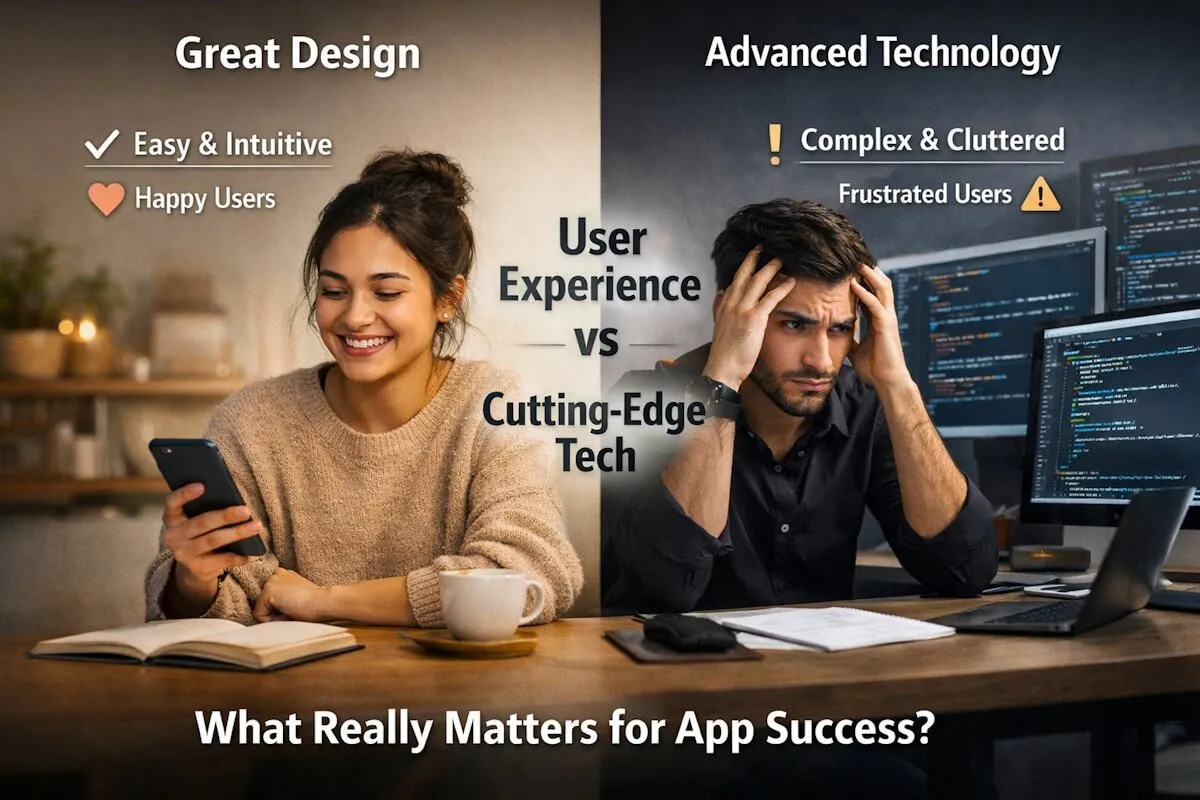
You can build an app using the latest stack, pack it with features, and still watch it fail. Sounds harsh, but it happens all the time.
People don’t fall in love with technology. They connect with how something feels when they use it.
That’s where UI and UX step in. Not as decoration. Not as an afterthought. They shape the entire experience.
So, let’s talk about why UI/UX often matters more than the tech behind your app and what that really means for you.
First Impressions Decide Everything
Users form an opinion within seconds. Sometimes even faster.
They open your app. They look around. They try one action.
If it feels confusing, slow, or cluttered, they’re gone.
No one cares if your backend is powerful if the first screen feels messy.
Think about your own behavior. When was the last time you stayed on an app that felt hard to use?
Exactly.
A clean layout, clear buttons, and smooth flow do more than look good. They build trust right away.
People Use Apps, Not Technology
This is where many businesses get it wrong.
They focus on frameworks, performance metrics, and architecture. All important, sure. But users don’t see any of that.
What users experience is:
- How easy it is to sign up
- How fast they find what they need
- How smooth the navigation feels
- How intuitive each step is
That’s UX.
And the visual side, colors, typography, spacing, that’s UI.
Together, they shape how people feel while using your app.
A great experience makes users stay. A poor one pushes them out, no matter how advanced your tech is.
Simplicity Wins Every Time
You don’t need to impress users with complexity.
In fact, complexity kills engagement.
Good UI/UX removes friction. It guides users without making them think too much.
Ever used an app where everything just felt obvious?
No instructions needed. No confusion.
That’s not luck. That’s thoughtful design.
It takes effort to make something simple. It takes planning, testing, and constant tweaking.
If your app needs a tutorial just to get started, something is off.
Speed Feels Different in Good Design
Here’s something interesting.
Two apps can have the same loading time, but one feels faster.
Why?
Because of design.
Micro-interactions, loading indicators, and smooth transitions create a sense of flow.
Users feel like things are happening instantly, even if they’re not.
Bad UI, on the other hand, makes everything feel slow and frustrating.
So yes, technology affects performance. But design shapes how that performance is perceived.
Retention Depends on Experience
Getting downloads is easy. Keeping users is the real challenge.
If your app doesn’t feel right, users won’t return.
They might try it once. Maybe twice. Then they forget about it.
Retention is built on comfort.
When users know exactly how your app works and enjoy using it, they come back.
Good UX creates habits. It makes your app part of their routine.
Without it, even the most advanced app becomes irrelevant.
Design Reduces Support Issues
Here’s something many teams overlook.
Poor UI/UX increases customer support requests.
Users get confused. They make mistakes. They can’t find features.
So they reach out for help.
Now your support team is overloaded, and your users are frustrated.
Good design prevents this.
It answers questions before users even ask them.
Clear navigation. Simple flows. Logical structure.
When everything makes sense, users don’t need help.
It Impacts Conversions Directly
If your app has a goal, sign-ups, purchases, bookings, UI/UX plays a huge role.
A small design change can increase conversions.
A clearer call-to-action. A shorter form. A better layout.
These things matter more than you might think.
Users don’t analyze your app. They react to it.
If something feels easy, they move forward.
If something feels annoying, they drop off.
So if you care about results, you can’t ignore design.
Technology Becomes Irrelevant Without Usability
Let’s be real.
You could build your app using the most modern tools available.
But if users struggle to use it, none of that matters.
Technology should support the experience, not define it.
That’s why many businesses are shifting focus.
Instead of asking, “What tech should we use?”
They’re asking, “What experience do we want to create?”
And that changes everything.
Where Flutter Fits Into This
Now, let’s connect this with development.
When you choose the right development approach, it becomes easier to deliver great UI/UX.
That’s where Flutter App Development Services come into play.
Flutter allows teams to build visually consistent apps across platforms.
It gives designers and developers more control over how things look and behave.
You can create smooth animations. Maintain design consistency. Reduce gaps between idea and execution.
But here’s the thing.
Even with Flutter, success depends on how well you plan your design.
The tool helps. The thinking behind it matters more.
The Role of Skilled Developers
Design alone isn’t enough.
You need developers who understand how to bring that design to life.
Not just functionally, but visually and interactively.
When you Hire Flutter Developers, you’re not just hiring coders.
You’re bringing in people who shape how your app feels in real use.
They handle transitions, responsiveness, and performance.
They make sure your app behaves exactly the way users expect.
And that’s where real value is created.
Consistency Builds Trust
Users notice inconsistencies, even if they don’t say it.
Buttons that behave differently. Screens that look unrelated. Flows that don’t match.
These small things add up.
They create doubt.
Consistency, on the other hand, builds confidence.
When everything feels connected and predictable, users feel in control.
That’s a big deal.
Because people stick with products they trust.
Emotional Connection Is Real
You might not think about it, but design creates emotion.
A smooth experience feels satisfying.
A cluttered one feels stressful.
Colors, spacing, motion, all of it affects mood.
And when users feel good using your app, they stay longer.
They come back. They recommend it.
That’s not about technology. That’s about experience.
Testing UI/UX Is Non-Negotiable
You can’t guess what works.
You need to test.
Watch how users interact with your app. Where they hesitate. Where they drop off.
Small observations lead to big improvements.
Sometimes a tiny tweak makes a huge difference.
This process never really stops.
Good apps keep improving their UI/UX based on real usage.
So, What Should You Focus On?
If you’re building an app, ask yourself:
- Is it easy to understand within seconds?
- Can users complete key actions without confusion?
- Does it feel smooth and natural?
- Would you enjoy using it yourself?
If the answer is no to any of these, that’s your starting point.
Fix the experience first.
Technology can support it later.
Let’s Wrap This Up in a Real Way
At the end of the day, users don’t care how your app is built.
They care about how it works for them.
They want speed, clarity, and ease.
They want something that just works without making them think too much.
You can have the best tech stack out there, but if your UI/UX is weak, your app won’t go far.
Flip that around.
A well-designed app with decent technology can still win.
So where should your focus be?
On the experience. Always.
Because that’s what users remember. And that’s what keeps them coming back.
